
Running a business in India has always meant navigating layers of HR, payroll, and compliance rules. With the Government notifying the four unified Labour Codes on 21 November 2025, this landscape has changed forever.
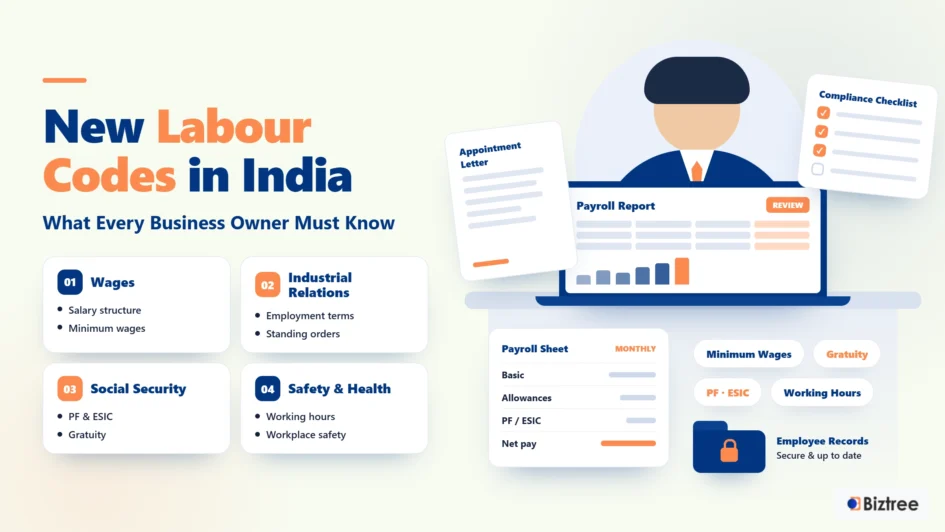
Running a business in India has always meant navigating layers of HR, payroll, and compliance rules. With the Government notifying the four unified Labour Codes on 21 November 2025, this landscape has changed forever. As a business owner, you now operate under a simplified yet more structured legal framework that replaces 29 earlier labour laws with four codes: the Wage Code, Industrial Relations Code, Social Security Code, and the Occupational Safety, Health, and Working Conditions Code.
Why This Reform Matters to Business Owners
These codes were introduced to reduce compliance complexity, bring uniformity to definitions such as “wages,” and expand social security coverage beyond traditional employment. Whether you are running a startup, a tech consultancy, or a growing service business, these codes directly affect employee contracts, salary structuring, payroll processes, and workplace responsibilities.
Impact on Salary Structures and Payroll
One of the most talked-about aspects is the redefined meaning of “wages”. Employers can no longer inflate allowances to keep the basic salary low. If allowances cross a certain threshold, the excess might be added back to wages. This will impact calculations for PF, gratuity, and bonus. For businesses offering flexible salary structures, this means revisiting CTC design to avoid unexpected statutory outflows.
How the New Labour Codes May Affect Salary Structures
The revised definition of wages is an important consideration when reviewing employee compensation. Under the Code on Wages, basic pay, dearness allowance and retaining allowance are included in wages, while certain other components are excluded subject to the statutory conditions. Where the specified excluded components exceed 50% of the applicable total remuneration, or another notified percentage, the excess is added back to wages under the statutory definition.
For employers, this means that a salary structure should not be reviewed solely on the basis of the basic salary or take-home pay. The applicable wage definition must be considered when calculating statutory benefits and contributions.
A practical payroll review should include:
- Mapping each salary component to the relevant statutory definition.
- Checking how allowances and exclusions affect the applicable wage calculation.
- Reviewing the impact on provident fund, gratuity and other relevant benefits.
- Testing payroll software calculations against the applicable rules.
- Explaining any compensation changes to employees before implementation.
The actual financial impact will depend on the employee’s salary structure, applicable statutory provisions and relevant notifications. Employers should verify these factors before changing compensation packages.
Social Security Now Goes Beyond Regular Employees
If your business relies on freelancers, gig workers, part-time roles, or fixed-term contracts, the compliance burden has increased. The Social Security Code extends benefits like gratuity, insurance, and welfare schemes to these categories. Traditional contractors can no longer be used to bypass employment benefits. This may increase costs, but it also creates a more stable workforce environment.
Hiring, Firing, and Industrial Relations Rules Have Changed
The Industrial Relations Code revises thresholds related to layoffs, retrenchment, and standing orders, giving medium-sized businesses more operational flexibility. However, this flexibility comes with expectations of transparent employment terms and dispute-resolution mechanisms. Businesses scaling beyond 100–300 employees must factor this into their growth strategy.
Safety, Working Hours, and Workplace Documentation
Workplace safety and health rules now apply with renewed rigor. The codes mandate clarity in working hours, restrictions on overtime, and additional compliance if women are deployed on night shifts. Mandatory appointment letters for every employee and unified registers for attendance, overtime, and wages have become non-negotiable. This pushes businesses towards structured HR documentation and leaves little room for informal practices.
The Transition Challenge for Business Owners
Although the codes are live, all states have not notified their respective rules. This has created a transition phase where old provisions may continue in parallel. Businesses must prepare for the shift now instead of waiting for enforcement drives and penalties. Early movers will find compliance easier and avoid disputes on wages, benefits, or working conditions.
Labour Codes Compliance Checklist for Employers
Businesses should review their employment practices, payroll systems and workplace documentation to identify changes required under the four Labour Codes. The review should consider the establishment’s size, industry, workforce categories and applicable Central and State requirements.
A practical compliance review should include:
- Salary structure: Review wage components, allowances and the applicable statutory calculation base.
- Employment documentation: Check appointment letters, employment contracts, policies and records against applicable requirements.
- Social security: Review the applicability of provident fund, gratuity, employee insurance and other statutory benefits.
- Working conditions: Check working hours, overtime, leave, workplace safety and applicable requirements for women working night shifts.
- Payroll records: Verify salary registers, attendance, deductions, payment records and statutory filings.
- Compliance calendar: Assign responsibility for monitoring notifications, payment deadlines, returns and documentation requirements.
Employers should document identified gaps, assign corrective actions and periodically review their compliance processes. The checklist should be updated whenever applicable rules or official notifications change.
How Businesses Should Prepare for Labour Code Implementation
Preparing for the Labour Codes requires more than updating payroll software. Employers should assess the applicable legal requirements, review existing HR practices and establish a process for responding to regulatory changes.
A practical implementation plan can follow these steps:
- Step 1: Conduct a gap assessment. Compare current payroll, HR documentation and workplace practices with the applicable requirements.
- Step 2: Review employee categories. Assess permanent, fixed-term, contract and other workforce arrangements according to the relevant legal definitions.
- Step 3: Validate payroll calculations. Check salary components, statutory contributions and benefit calculations before implementing changes.
- Step 4: Update documentation. Revise employment letters, policies, registers and internal procedures where required.
- Step 5: Train HR and finance teams. Explain revised processes, approval responsibilities and record-keeping expectations.
- Step 6: Monitor official updates. Track Central Government and relevant State Government notifications, rules and clarifications.
The Ministry of Labour and Employment publishes official information on the four Labour Codes. Businesses should use these materials alongside applicable Gazette notifications and State-specific guidance when determining their obligations.
How Biztree Outsourcing Can Help Your Business Transition Smoothly
Biztree Outsourcing provides end-to-end support in understanding and implementing the new Labour Codes without disrupting daily operations. Our team reviews your payroll structure, employee contracts, and HR policies to ensure full compliance with the revised definition of wages and statutory rules on PF, ESIC, and gratuity. We redesign CTC components to balance compliance requirements with take-home salary expectations, helping you avoid sudden increases in employer contributions or liabilities.
We also implement compliant onboarding processes, appointment letters, and digital registers aligned with new documentation norms. For businesses employing gig workers, consultants, or fixed-term staff, Biztree Outsourcing evaluates social security applicability and sets up systems to correctly track service duration, overtime, and benefit eligibility.
Frequently Asked questions
They are the Code on Wages, Industrial Relations Code, Code on Social Security, and Occupational Safety, Health and Working Conditions Code. Together, they consolidate 29 central labour laws.
The Labour Codes were notified by the Central Government on 21 November 2025. However, implementation depends on individual state rules, so businesses should monitor state-specific notifications.
The revised definition of wages can increase the portion of salary considered for PF, gratuity, bonus, and other statutory benefits. Employers may need to redesign salary structures and update payroll systems.
Wages include basic pay, dearness allowance, and retaining allowance. If excluded allowances exceed the prescribed limit, the excess may be treated as wages for statutory calculations.
Potentially yes. If more salary components are classified as wages, both employer and employee provident fund contributions may increase.
Yes. Startups are generally covered by the Labour Codes. While some compliance thresholds vary, businesses must follow applicable rules relating to wages, employment documentation, and statutory obligations.




 Bookkeeping & Accounting
 Payroll Processing & Compliances
 Tax Compliance & Solutions
 Zoho Finance Services
 Virtual CFO Services
Leave a Reply