
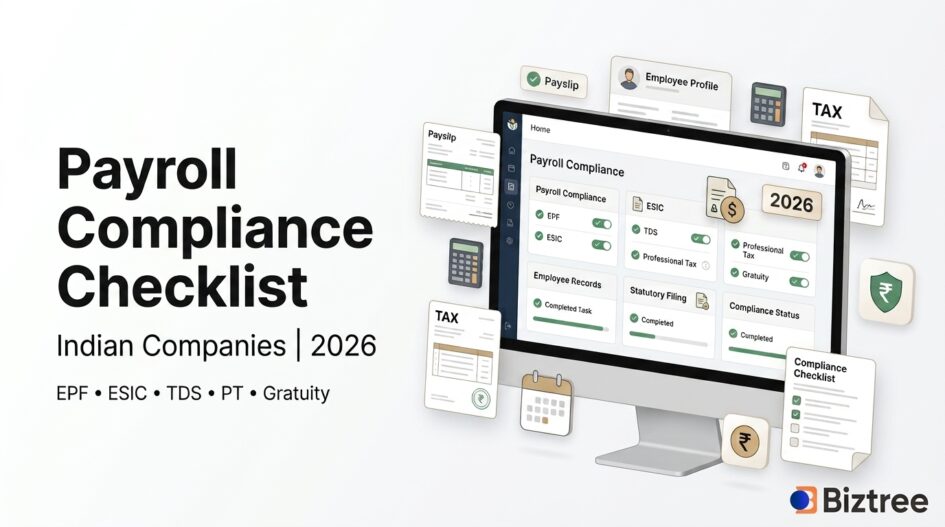
A working reference for HR managers, founders, and finance teams — what to verify before, during, and after every payroll cycle in 2026.
A company can process salaries correctly every month and still be non-compliant. Correct payroll and compliant payroll are not the same thing — statutory deductions, employee documentation, filings, and state-specific requirements sit outside the salary calculation itself, and gaps in these areas rarely show up until a labour inspection, a funding due-diligence exercise, or an employee dispute forces the issue. This is compounded by the shift to the four Labour Codes and the revised statutory definition of “wages,” which changes how PF, ESIC, and gratuity are calculated for many salary structures.
This checklist is built for HR managers, founders, and finance teams who need a working reference — not another explainer — for what to verify before, during, and after every payroll cycle in 2026.
What Is Payroll Compliance in India?
Payroll compliance means correctly calculating, deducting, depositing, and reporting every statutory obligation tied to employee wages — on time, with accurate records to prove it. It covers four things together: getting the salary calculation right under the current wage rules, deducting and depositing statutory contributions (EPF, ESIC, TDS, Professional Tax, and others where applicable), filing the associated returns, and maintaining documentation that would hold up in an audit. Missing any one of these — even with accurate salary payments — counts as a compliance gap.
Why Payroll Compliance Matters for Indian Companies in 2026
Two changes make 2026 a genuine inflection point rather than routine upkeep.
First, the four Labour Codes — the Code on Wages, the Industrial Relations Code, the Code on Social Security, and the Occupational Safety, Health and Working Conditions Code — came into effect from 21 November 2025, replacing 29 earlier central labour laws. Second, the Code on Wages sets a statutory definition of “wages” with a specific list of included and excluded components. Certain components — HRA, conveyance allowance, employer PF/pension contributions, statutory bonus, overtime, and a few others — are expressly excluded from wages, but a proviso caps that exclusion: if these excluded components together exceed 50% of an employee’s total remuneration, the excess is added back to “wages” for calculating PF, gratuity, bonus, and similar statutory dues. Gratuity itself and retrenchment compensation stay excluded regardless.
In practice this means employers need to review actual salary structures against this mechanism — it is more precise than the shorthand “Basic + DA must be 50% of CTC,” which is a common but incomplete simplification of the rule.
The four Codes are in force, but rules under each Code are being notified progressively — some centrally, some by individual states — and not every state has finalised its own rules yet. Employers should verify the specific rules, notifications, and state or establishment-specific requirements applicable to their workforce, rather than treat the Codes’ commencement date alone as settling every compliance question. See Biztree’s breakdown of the new Labour Codes for the fuller framework, and the 50% wage rule explainer for how the wage-definition mechanism plays out in an actual CTC structure. Common payroll compliance mistakes at this stage of a company’s growth are covered in Biztree’s related piece on payroll compliance mistakes Indian startups must avoid — worth reading alongside this checklist rather than instead of it, since that article focuses on errors and this one focuses on ongoing verification.
Payroll Compliance Requirements in India: What Actually Applies
Requirements are not uniform across companies. What applies to a given employer depends on:
- Employee count (several obligations, including ESIC and gratuity, trigger only above a headcount threshold)
- Salary levels of individual employees (EPF and ESIC apply based on wage ceilings, not company-wide)
- State (Professional Tax, Labour Welfare Fund, and shop/establishment rules vary by state)
- Establishment type (factory, shop, IT/ITES entity, and so on)
- Nature of engagement (permanent, contract, fixed-term, or gig/platform worker — coverage has expanded under the Social Security Code)
Because of this, a payroll compliance checklist has to be checked per employee and per state, not applied as one blanket rule across the company.
5 Key Areas of Payroll & HR Compliance
- Wage and salary compliance — salary structuring reviewed against the statutory wage definition, correct gross-to-net calculation, accurate handling of allowances, overtime, and arrears.
- Social security compliance — EPF and ESIC applicability, contribution calculation, and timely deposit for every eligible employee.
- Tax and payroll deduction compliance — TDS on salary, Professional Tax, and Labour Welfare Fund where applicable.
- Employment and HR documentation — appointment letters, employee master data, KYC, and policy acknowledgements that support every payroll calculation.
Records, reporting and statutory filings — payroll registers, statutory returns, and the current salary-TDS forms (see the Form 138/Form 130 note below), kept audit-ready.
Payroll Compliance Checklist for Indian Companies
Before Payroll Processing
Employee master data is current (bank details, PAN, UAN, ESIC number where applicable)
New joiner documentation is complete before the first payroll run
Attendance and leave data for the cycle is finalised
Salary structure has been reviewed against the current statutory wage definition, including the 50% cap on excluded components
Tax regime declarations and investment proofs are recorded for the relevant employees
PF and ESIC applicability has been checked for every employee, including recent salary revisions
Professional Tax slab is confirmed for the employee’s state Any mid-cycle change in salary, designation, or benefits is reflected before processing
During Payroll Processing
Gross salary and each wage component (Basic, DA, allowances) are calculated correctly
Deductions are applied in the correct order and against the correct wage base
TDS on salary is computed against the applicable regime and slab (Biztree’s tax compliance & solutions service handles this alongside GST and other direct/indirect tax filings)
EPF contribution is calculated on the correct wage base (statutory ceiling of ₹15,000/month for mandatory contribution — re-notified on 29 May 2026 under the Code on Social Security and unchanged since 2014, though a proposed increase to ₹25,000 remains pending — unless the employee has opted for higher voluntary contribution)
ESIC applicability is checked employee-by-employee against the current wage ceiling and confirmed against establishment coverage and contribution-period rules — not assumed from gross salary alone
Professional Tax is deducted per the applicable state slab
Labour Welfare Fund is deducted where the state and establishment require it
Leave deductions, overtime, bonus, incentives, reimbursements, and arrears are correctly reflected Full and final settlement is processed accurately for any employee exiting the cycle.
After Payroll Processing
Payslips are generated and shared with every employee
Net salary is disbursed on schedule
Statutory payments (EPF, ESIC, TDS, Professional Tax, LWF where applicable) are deposited within the prescribed timelines
Payroll is reconciled against accounting entries
Employee records and statutory registers are updated Documentation supporting the cycle is filed in a way that would withstand an audit.
Quick Payroll Compliance Check
Before diving into the full checklists below, a business owner or HR manager should be able to answer these ten questions honestly and quickly — if any answer is “not sure,” that’s the place to start.
- Are employee records current?
- Are salary structures reviewed against the current statutory wage definition?
- Are EPF and ESIC obligations correctly determined for each employee?
- Is salary TDS correct?
- Is Professional Tax applicable, and is it being deducted?
- Were statutory payments made on time?
- Were the required returns filed?
- Are payslips available for every employee?
- Do payroll and accounting records reconcile?
Can the company produce supporting records if audited?
Monthly Payroll Compliance Checklist
Verify employee master data and any changes since the last cycle
Verify attendance and leave records
Process salary in line with the current wage definition
Calculate EPF, ESIC, TDS, and Professional Tax correctly
Check Labour Welfare Fund where applicable to the state
Generate and distribute payslips
Process salary payment
Deposit EPF and ESIC contributions (typically due by the 15th of the following month — confirm against the current EPFO/ESIC notification for your establishment)
Deposit TDS on salary (typically due by the 7th of the following month, with a separate deadline for March)
Reconcile payroll output with accounting records
File any monthly or half-yearly statutory return that falls due
Maintain payroll records for the cycle
Payroll Compliance Calendar
| Compliance Area | Frequency | What to Verify | Responsible Team |
| Payroll processing | Monthly | Salary, deductions and payroll changes | HR / Payroll |
| EPF | Monthly | Applicability, contribution and payment | Payroll / Finance |
| ESIC | Monthly / periodic | Coverage, contribution and applicable returns | HR / Payroll |
| Professional Tax | State-specific | Deduction, payment and return | Payroll / Finance |
| Salary TDS | Monthly / quarterly | Deduction, payment and reporting | Finance / Payroll |
| Employee records | Ongoing | Joiners, exits and changes | HR |
| Gratuity / Bonus | Periodic / event-based | Eligibility and calculation | HR / Finance |
This calendar shows typical frequency, not fixed universal deadlines — exact due dates depend on the state, the return type, and the current government notification in force. Confirm current deadlines against EPFO, ESIC, and Income Tax Department sources before relying on any date for filing.
Annual Payroll Compliance Checklist
Issue the annual salary TDS certificate — Form 16 for FY 2025-26 (due 15 June 2026), and Form 130 for salary paid from 1 April 2026 onward under the Income-tax Act, 2025 (see the note on Form 138/Form 130 below)
Complete annual salary and TDS reconciliation
Collect fresh tax regime declarations for the new financial year
Review the payroll master for accuracy — salary structures, bank details, PAN/UAN linkage
Review gratuity eligibility and accrual for the year, distinguishing permanent employees from fixed-term employees (see the gratuity note below)
Review statutory bonus eligibility and calculation (see Biztree’s gratuity guide for the related eligibility formula and tax treatment)
Update employee records for promotions, transfers, and exits during the year
Complete full and final settlements for all employees who exited during the year
Conduct a payroll audit covering wage structuring, deductions, and filings
Review statutory registers and retained records for completeness
Review HR and payroll policies against any regulatory change during the year Check state-specific obligations for every state the company operates in
HR Compliance Checklist Used in India
HR compliance and payroll compliance overlap but are not the same thing. Payroll compliance is about calculating and depositing money correctly. HR compliance is about the documentation, policies, and processes that make those calculations defensible and that govern the employment relationship itself.
Appointment letters issued for every employee, aligned with current wage and documentation norms
Employee KYC and identification records maintained
Employment agreements reflect current terms, including for fixed-term and gig workers where the Social Security Code applies
Salary structure documented and consistent with payroll records
Attendance and leave records maintained accurately
Employee policies (leave, POSH, code of conduct) documented and communicated
POSH compliance maintained where applicable to the establishment
Minimum wage compliance verified against the applicable state schedule
Working hours and overtime tracked against current limits
Termination and full & final settlement process documented and followed
Gratuity records maintained for eligible employees
Statutory registrations current (EPF, ESIC, Shops & Establishment, Professional Tax, and others as applicable) State-specific labour requirements reviewed for every location of operation.
Legal Requirements for HR Compliance in India
What legally applies to a given company depends on state, establishment type, employee count, nature of business, wage levels, and any specific government notification affecting that sector. A 15-person Pune-based SaaS company and a 400-person manufacturing unit in another state are not subject to identical obligations, even though both fall under the same Labour Code framework.
Because the four Labour Codes are still in a state-by-state rules-notification phase, the safest working assumption for 2026 is: confirm applicability at the state and establishment level before assuming either full exemption or full applicability. Do not rely on last year’s compliance list without re-checking it against current notifications.
In practice, this state layer shows up most often in Professional Tax slabs, Labour Welfare Fund applicability and contribution amounts, Shops and Establishments registration and renewal rules, leave entitlements, working-hour limits, and the specific registers a state inspector expects to see. A national checklist is a starting point — it still needs a state-specific layer added for each location where the company employs people.
The Wage Definition, Gratuity, and TDS Forms: What Changed for 2026
The Wage-Definition Mechanism (the “50% Rule”)
The Code on Wages defines “wages” broadly, then lists specific excluded components — including HRA, conveyance allowance, employer PF/pension contributions, statutory bonus, overtime, and a few others. A proviso caps that exclusion list: if the excluded components together exceed 50% of an employee’s total remuneration, the excess is added back into “wages” for statutory calculations such as PF, gratuity, and bonus. Gratuity and retrenchment compensation are not subject to this add-back.
For payroll purposes this means reviewing the actual salary structure against the inclusion/exclusion list and the 50% proviso — not simply checking whether Basic Pay looks like roughly half of CTC. Where a company’s allowances-heavy structure fails this test, the excess is treated as wages, which raises the PF and gratuity base and increases both employee deduction and employer contribution.
Gratuity: What Actually Determines Eligibility
Gratuity eligibility is not just a function of headcount. The Payment of Gratuity Act applies to establishments with 10 or more employees. Within a covered establishment, permanent employees still need 5 years of continuous service to qualify. A 2026 change under the Code on Social Security brings fixed-term employees into gratuity eligibility on a pro-rata basis after just 1 year of continuous service, rather than the 5-year requirement that continues to apply to permanent staff. Gratuity itself remains calculated on the last drawn Basic + DA using the standard 15/26 formula, and stays fully excluded from the 50% wage add-back described above.
ESIC: What Determines Coverage
ESIC applicability is not simply “gross salary at or below ₹21,000.” It depends on establishment coverage (broadly, 10 or more employees in most states, though the threshold varies by state and establishment type), individual employee wage levels against the current ceiling (₹21,000/month for most employees, ₹25,000/month for persons with disabilities, as of 2026), and the ESI contribution-period rules — an employee who crosses the ceiling mid-period typically stays covered until the end of that contribution period rather than being dropped immediately. Confirm the current ceiling and your establishment’s coverage status against ESIC notifications before relying on a fixed number.
Form 24Q → Form 138, and Form 16 → Form 130
Under the Income-tax Act, 2025, the quarterly salary-TDS statement (formerly Form 24Q) is renamed Form 138, and the annual salary TDS certificate (formerly Form 16) is renamed Form 130. This applies to salary paid from 1 April 2026 onward (Tax Year 2026-27) — the first statement on Form 138 covered Q1 FY 2026-27 and fell due on 31 July 2026. Quarterly due dates themselves are unchanged: 31 July, 31 October, 31 January, and 31 May. Salary paid up to 31 March 2026 (FY 2025-26) continues to be reported on the earlier Form 24Q, with Form 16 for that year due by the applicable statutory deadline following year-end. Payroll teams filing returns for periods spanning the transition should double-check which form applies to which period, since the two frameworks run in parallel for a time rather than one simply replacing the other overnight.
Payroll Compliance in a Private Limited Company
A private limited company does not automatically attract every payroll obligation listed in this article — applicability depends on employee count, salary thresholds, establishment type, state, employee category, and other statutory conditions. The question worth asking is not “which of these apply to every Pvt Ltd company” but “which of these apply to this specific company, given its headcount, states of operation, and workforce mix.”
Where applicable, a Pvt Ltd company should regularly review:
- Employee records and salary structuring against the current wage definition
- EPF applicability and contribution accuracy for employees at or near the ₹15,000 wage ceiling
- ESIC applicability, checked against establishment coverage and current wage ceilings rather than assumed
- Professional Tax deduction per the state where employees are based
- TDS on salary — reported on Form 24Q for periods up to 31 March 2026, and on Form 138 (its successor) for salary paid from 1 April 2026 onward
- Annual salary TDS certificates — Form 16 for FY 2025-26, and Form 130 for salary paid from 1 April 2026 onward (see the note on Form 138/Form 130 above)
- Gratuity eligibility, reviewed against establishment coverage, employee category (permanent vs fixed-term), and qualifying service — not just headcount
- Statutory bonus applicability for eligible wage bands
- Labour Welfare Fund where the state requires it
- Leave-related statutory requirements (earned leave, sick leave per state Shops & Establishment rules)
- Payslip issuance and attendance record maintenance
- Full and final settlement process and timelines for exiting employees
- Statutory registers and records required to be maintained
- State-specific requirements for every location the company operates from.
What Are the 7 Pillars of Compliance?
- Legal requirements — knowing which laws and thresholds actually apply to your establishment
- Employee documentation — appointment letters, KYC, and agreements that support every payroll entry
- Payroll accuracy — correct wage calculation under the current definition of wages
- Statutory deductions and contributions — EPF, ESIC, TDS, Professional Tax, LWF calculated correctly
- Filing and payment deadlines — deposits and returns filed on time
- Records and audit trails — documentation that would hold up under inspection or due diligence
- Monitoring and continuous review — regularly re-checking applicability as headcount, wages, and regulations change
This is a practical framework for organising payroll and HR compliance work — not a statutory framework formally prescribed under a single Indian law.
What Are the Fundamentals of Payroll Compliance?
- Know which laws apply to your establishment and states of operation
- Maintain accurate, current employee data
- Calculate salaries correctly under the current wage definition
- Deduct and deposit statutory amounts on time
- File the required returns
- Maintain records that support every calculation
- Monitor regulatory changes, including state-level Labour Code rules
- Conduct periodic compliance checks rather than relying on an annual review alone.
What Are the 3 C’s of Compliance?
- Commitment — leadership and HR treating compliance as a standing responsibility, not a year-end task
- Consistency — applying the same checks and standards across every payroll cycle and every employee category
- Continuous monitoring — reviewing applicability and accuracy on an ongoing basis rather than only when a law changes
There isn’t a single legally mandated “3 C’s of compliance” framework specific to Indian payroll law — this is a commonly used practical mnemonic, not a citation of statute.
How to Check HR Compliance?
Start by identifying which laws apply to your establishment, then work through documentation, payroll, and filings in sequence.
- Identify applicable laws based on state, establishment type, and headcount
- Check that all required statutory registrations are current
- Review employee documentation for completeness
- Audit payroll calculations against the current wage definition
- Verify statutory deductions (EPF, ESIC, TDS, PT, LWF)
- Confirm payments and filings were made on time
- Review HR policies for currency and applicability
- Check that records are complete and retrievable
- Identify and log any gaps found
- Maintain a compliance tracker to follow up on open items.
What Are the Key Elements of Compliance?
- Applicable laws — the specific statutes and thresholds relevant to your establishment
- Policies and procedures — documented HR and payroll processes
- Responsibilities — clear ownership of each compliance area
- Documentation — records that support every payroll and HR decision
- Controls — checks built into the payroll process itself, not added after the fact
- Monitoring — regular review rather than one-time setup
- Reporting — timely statutory filings
- Corrective action — a process for fixing identified gaps
How to Make a Payroll Compliance Checklist
- List the laws applicable to your establishment and states of operation
- Identify specific obligations under each law
- Assign a frequency to each obligation (monthly, quarterly, annual)
- Assign a responsible person for each item
- Add the relevant deadline
- Note the documents required to evidence compliance
- Build in a verification step before sign-off
- Track completion for every cycle
- Record exceptions and the reason for them
- Review and update the checklist periodically as regulations or headcount change
Common Payroll Compliance Gaps to Watch
These are gaps that typically surface during a compliance review, not a list of common mistakes:
- Salary structures not reviewed against the current wage definition, leaving PF and gratuity calculated on an outdated base
- ESIC coverage assumed from gross salary alone, without checking establishment coverage or contribution-period rules
- Contract or gig worker arrangements not reassessed against expanded Social Security Code coverage, including the fixed-term gratuity change
- State-specific Professional Tax or LWF obligations overlooked when a company hires in a new state
- Statutory registers not maintained consistently, creating gaps that only surface during an audit or funding due diligence
- TDS filings still referencing Form 24Q or Form 16 for salary paid on or after 1 April 2026, when Form 138 and Form 130 are the applicable forms
Payroll Compliance Audit: What Should You Review?
A payroll compliance audit should independently verify, not just re-run, the payroll process. The table below is a practical starting checklist for that review.
| Audit Check | What to Verify | Evidence / Record |
| Salary structure | Compliance with the current statutory wage definition | Salary structure / CTC sheet |
| EPF | Correct applicability and wage base | ECR, challan, contribution records |
| ESIC | Coverage and contribution accuracy | ESIC contribution records |
| TDS | Deduction and reporting accuracy | TDS records and returns |
| Professional Tax | State applicability and deduction | PT records |
| Employee records | Completeness of documentation | Employee files |
| Full & final settlement | Correct calculation and documentation | F&F statement |
| Payroll reconciliation | Payroll figures vs accounting records | Payroll reconciliation sheet |
Larger companies running this kind of review as part of broader financial planning often fold it into a wider strategic exercise; smaller companies more commonly run it as a standalone annual or pre-funding re
Conclusion
Payroll compliance in 2026 is less about knowing the rules once and more about re-checking them regularly — the wage-definition mechanism and the state-by-state rollout of the Labour Codes mean applicability can shift under a company without any internal change at all. A working checklist, reviewed monthly and audited annually, is what actually catches that drift before an inspection or a due-diligence process does.
Biztree Accounting’s payroll processing and compliance services handle this end-to-end for Indian startups, SMEs, and private limited companies — from monthly statutory deposits to annual reconciliation. For related reading, see the breakdown of the 50% wage rule, the fuller picture of the new Labour Codes, and, for Pune-based teams, payroll and compliance challenges for businesses in Pune.
Frequently Asked Questions
List every component of the employee’s total remuneration, then separate out the components the Code on Wages excludes — HRA, conveyance allowance, employer PF and pension contributions, statutory bonus, and overtime. If those excluded components together exceed 50% of total remuneration, the excess is added back to “wages,” and PF, gratuity, and bonus are recalculated on that higher base. Gratuity and retrenchment compensation are not subject to the add-back.
There is no universally prescribed statutory classification of “four types” of payroll. In practice, Indian businesses commonly describe payroll models as in-house, outsourced, software-assisted, and hybrid (a mix of in-house and outsourced).
A practical framework covering legal requirements, employee documentation, payroll accuracy, statutory deductions, filing deadlines, records and audit trails, and continuous monitoring — not a formally codified Indian statutory list.
Commitment, Consistency, and Continuous monitoring — a commonly used practical mnemonic, not a legally mandated Indian framework.
Identify applicable laws, check registrations, review documentation, audit payroll, verify statutory deductions, confirm filings, review policies, check records, log gaps, and maintain a compliance tracker.
Applicable laws, policies and procedures, defined responsibilities, documentation, built-in controls, ongoing monitoring, timely reporting, and a process for corrective action.
List applicable laws, identify obligations, assign frequency and ownership, add deadlines and required documents, build in verification, track completion, log exceptions, and review the checklist periodically.



 Bookkeeping & Accounting
 Payroll Processing & Compliances
 Tax Compliance & Solutions
 Zoho Finance Services
 Virtual CFO Services
Leave a Reply