
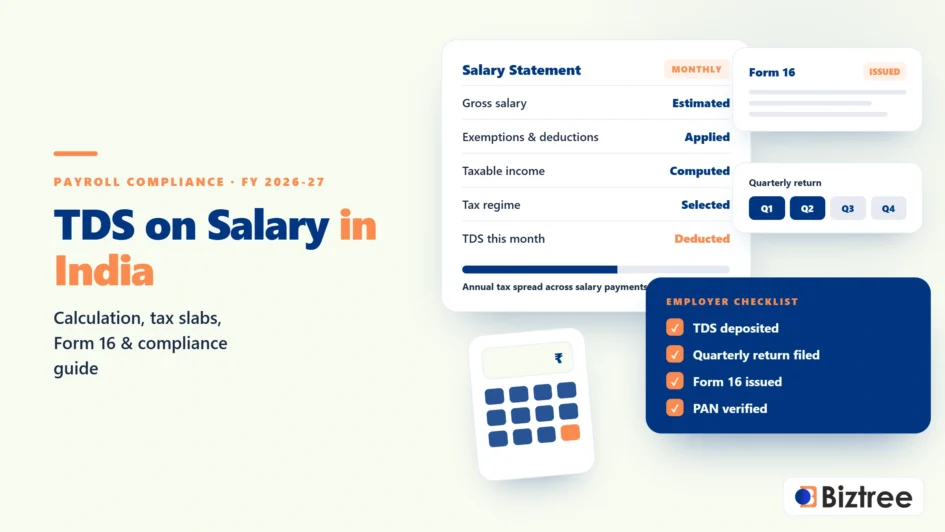
TDS on salary is calculated under Section 192 of the Income-tax Act, 1961, for the applicable period by estimating an employee’s annual taxable salary and expected income tax liability. The employer considers the employee’s chosen tax regime, eligible exemptions and deductions, applicable tax slabs, and any other relevant income details. The estimated tax is generally deducted from salary payments during the financial year and adjusted when salary or tax declarations change. For salary payments from 1 April 2026 onwards, employers should refer to the applicable provisions of the Income-tax Act, 2025, and the relevant rules for the financial year.
Introduction
Tax Deducted at Source (TDS) on salary is a crucial responsibility for every employer in India. Under Section 192 of the Income Tax Act, employers must calculate and deduct TDS when an employee’s salary exceeds the basic exemption limit. This guide will walk you through the entire process, from calculation to compliance.
For salary TDS, an employer estimates the employee’s taxable salary for the financial year and calculates the expected tax liability based on the applicable tax regime, eligible exemptions and deductions, and applicable tax rates. The estimated tax is then generally recovered through deductions from salary during the year. The calculation may need to be revised when an employee’s salary, investment declarations, perquisites, or other relevant income details change.
For salary paid from April 2026 onwards, employers should also consider the transition to the Income-tax Act, 2025 and the corresponding changes to tax administration and compliance requirements. Salary TDS calculations should therefore be reviewed using the rules and forms applicable to the relevant financial year rather than relying on older FY 2024-25 guidance.
TDS Calculation Process
Step 1: Calculate Gross Annual Salary
First, determine the employee’s total annual income by including:
- Basic salary
- Allowances (HRA, transport allowance, etc.)
- Perquisites
- Bonuses and commissions
Step 2: Consider income & deductions submitted by employee through Form 12BB
Subtract the following eligible deductions:
- Standard deduction
- Professional tax
- Section 80C investments (up to ₹1.5 lakhs)
- Section 80D health insurance
- Housing loan interest (Section 24)
- Other applicable deductions
Step 3: Calculate Taxable Income as per the regime chosen by the employee.
After applying all eligible deductions, you’ll arrive at the taxable income figure.
TDS Rate Chart for FY 2024-25
New Tax Regime
| Income Slab | Tax Rate |
|---|---|
| Up to ₹3,00,000 | Nil |
| ₹3,00,001 – ₹6,00,000 | 5% |
| ₹6,00,001 – ₹9,00,000 | 10% |
| ₹9,00,001 – ₹12,00,000 | 15% |
| ₹12,00,001 – ₹15,00,000 | 20% |
| Above ₹15,00,000 | 30% |
Old Tax Regime
| Income Slab | Tax Rate |
|---|---|
| Up to ₹2,50,000 | Nil |
| ₹2,50,001 – ₹5,00,000 | 5% |
| ₹5,00,001 – ₹10,00,000 | 20% |
| Above ₹10,00,000 | 30% |
How Is Monthly TDS on Salary Calculated?
Monthly salary TDS is generally determined by estimating the employee’s total tax liability for the financial year and spreading the remaining tax liability over the remaining salary payments. The employer considers salary already paid, TDS already deducted, eligible exemptions and deductions, the employee’s selected tax regime, applicable tax rates, and other relevant components while calculating the remaining TDS.
A simplified calculation is:
Remaining TDS liability ÷ Remaining salary payments = Approximate TDS to be deducted from each remaining salary payment
The actual deduction can change during the year if there are changes in salary, bonuses, taxable perquisites, investment declarations, deductions, or other information provided by the employee. Employers should therefore review salary TDS calculations periodically instead of treating the monthly deduction as a fixed amount throughout the year.
Important Deadlines and Compliance
TDS Deposit Timeline
- For tax deducted from April to February: Due by 7th of the following month
- For March deductions: Due by April 30th
Quarterly Return Filing Deadlines for FY 2024-25
| Quarter | Period | Due Date |
|---|---|---|
| Q1 | April – June | July 31, 2024 |
| Q2 | July – September | October 31, 2024 |
| Q3 | October – December | January 31, 2025 |
| Q4 | January – March | May 31, 2025 |
Essential Compliance Requirements
- TDS Certificate (Form 16)
- Must be issued annually by May 31st
- It should contain complete salary and tax details for the entire financial year
- Quarterly Returns
- File Form 24Q for salary TDS
- Include all employee details and tax deduction information
- Submit within prescribed deadlines to avoid penalties
- PAN Verification
- Verify the employee’s PAN before processing the salary
- A higher TDS rate applies if PAN is not provided
Best Practices
- Regular Updates
- Keep track of tax slab changes
- Monitor deduction proofs submitted by employees
- Update tax calculation software regularly
- Documentation
- Maintain proper records of all TDS-related documents
- Keep copies of investment proofs
- Store Form 16 and other tax certificates securely
- Employee Communication
- Inform employees about monthly TDS deductions
- Provide quarterly updates on tax liability
- Help employees plan their tax savings
TDS Is Only One Part of Payroll Compliance
Salary TDS is an important part of payroll processing, but employers also need to manage other applicable payroll compliances. Depending on the organisation, these may include Provident Fund (PF), Employees’ State Insurance (ESI), Professional Tax, salary records, payslips, TDS returns, Form 16 and employee documentation.
Businesses with multiple employees should maintain a systematic payroll process so that salary calculations, statutory deductions, TDS payments and periodic filings are completed accurately and on time. A structured payroll compliance process can also reduce calculation errors and the risk of missed statutory deadlines.
Common Mistakes to Avoid
- Incorrect tax regime selection
- Missing investment declaration deadlines
- Wrong calculation of taxable perquisites
- Delayed TDS deposits
- Incomplete employee records
Conclusion
Employers must stay vigilant and comply with the TDS rules throughout the year. This process requires accurate calculations, timely deposits, and regular employee communication. By following the steps outlined in this guide and adhering to compliance deadlines, employers can ensure smooth TDS management and avoid penalties.
Frequently Asked Questions
TDS on salary is calculated by estimating the employee’s annual taxable income, applying the applicable tax regime and rates, considering eligible deductions and rebates, and deducting the resulting tax through salary payments during the year.
TDS depends on the employee’s estimated taxable income, applicable tax regime, deductions, exemptions and rebate eligibility. Therefore, there is no single salary amount at which TDS applies to every employee.
Yes. Employers generally deduct salary TDS from monthly salary payments based on the employee’s estimated annual tax liability and adjust the deduction when salary or tax-related details change.
Form 16 is the TDS certificate issued by an employer for salary income. It contains details of salary paid, TDS deducted and other relevant tax information for the applicable financial year.
Late deposit of salary TDS can result in interest and other consequences for the employer. Employers should deposit deducted TDS within the prescribed due dates and maintain proper payroll and TDS records.
Accounting & Payroll Resources – Guides for Startups & MSMEs



 Bookkeeping & Accounting
 Payroll Processing & Compliances
 Tax Compliance & Solutions
 Zoho Finance Services
 Virtual CFO Services