
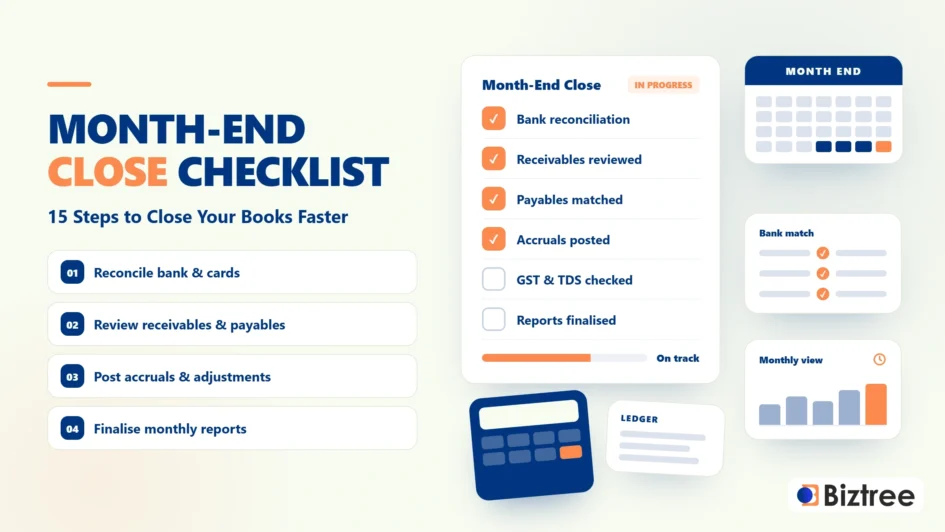
Quick answer: A month-end close checklist is a fixed, ordered list of tasks that confirms every transaction for the month is recorded, reconciled, adjusted and reviewed before the period is locked. For most Indian small businesses this comes down to 15 steps, from confirming the cut-off and reconciling bank, UPI and GST data to reviewing the profit and loss statement and signing off.
Month-End Close Checklist at a Glance
Before you start, confirm the cut-off so that bookkeeping for the month is complete. Then work through these 15 steps:
- Reconcile bank accounts, UPI receipts and payment gateway settlements
- Reconcile accounts receivable and flag overdue customers
- Reconcile accounts payable and confirm MSME dues
- Review payroll, reimbursements and related entries
- Reconcile GST records with the books
- Check TDS deducted, deposited and recorded
- Review inventory and cost of goods sold
- Book unbilled and deferred revenue
- Record accruals and outstanding expenses
- Review prepaid expenses, depreciation and provisions
- Revalue foreign currency balances
- Review loans, advances and other balance-sheet accounts
- Investigate exceptions and unreconciled balances
- Prepare and review the month-end financial statements
- Approve, lock the period and retain records
Each step is explained below, and you can download the free Excel template to track them.
If your close drags into the second or third week, the cause is usually the backlog in front of it: invoices in WhatsApp chats, late supplier bills, UPI receipts with only a reference number, and books never matched to GST data. This month-end close checklist for Indian small businesses sets out the order to work in, whether you use Tally, Zoho Books or another system. Two points first:
- Closing your books is not the same as filing returns. The close is an internal routine with no statutory deadline. GST, TDS and payroll filings have their own legal due dates, which apply only if you are registered for or liable to them.
Not every step applies to every business. Steps marked “Applies if” depend on your registrations, employees, inventory and structure. Your chartered accountant should confirm what applies to you.
What Is Month-End Closing?
Month-end closing is the process of finalising a month’s accounts so the numbers can be relied on. It confirms every transaction is in the right month, reconciles the books with outside records such as bank statements and GST data, posts adjustments such as accruals and depreciation, and locks the period. It sits between routine bookkeeping, which records transactions as they happen, and year-end finalisation, which produces statutory financial statements. Good monthly bookkeeping practices keep the close short.
Month-End Closing vs Statutory Filing and Payment Deadlines
You set the timetable for your close. The law sets the deadlines for returns and tax payments, and they apply only if the obligation applies to you. The table lists common monthly obligations for reference; it is not a complete compliance calendar, and due dates can be extended by government notification.
| Obligation | Applies if | Usual due date | Official source |
| TDS deposit | You are required to deduct TDS | 7th of the following month; TDS deducted in March by 30 April (non-government deductors) | Income Tax Department FAQ |
| GSTR-1 (outward supplies) | You are GST-registered | 11th of the following month (monthly filers); 13th of the month after the quarter (quarterly filers) | GST portal: GSTR-1 FAQ |
| GSTR-2B (input tax credit statement, not a return) | You are GST-registered | Generated on the 14th of the following month; can be recomputed after Invoice Management System (IMS) changes, before you file GSTR-3B | GST Council newsletter, Nov 2024 |
| GSTR-3B (summary return and tax payment) | You are GST-registered | 20th of the following month (monthly filers); 22nd or 24th of the month after the quarter for QRMP filers, depending on the state (Maharashtra: 22nd) | CGST Rule 61 (CBIC) |
| GST payment in PMT-06 | You are a QRMP filer, months 1 and 2 of the quarter | 25th of the following month | CGST Rule 61 (CBIC) |
| PF, ESIC, professional tax | Your establishment and employees are covered | Varies by scheme and state | See our payroll compliance checklist |
In practice, the TDS working comes early in the close, ahead of the 7th. GST input tax credit matching usually finishes after the close, because GSTR-2B is not available until the 14th.
Why Is a Month-End Closing Checklist Important?
A written checklist makes the close repeatable instead of relying on one person’s memory. Every account is checked against an outside source each month, errors surface while they are still easy to trace, you can see what cash you have and what is stuck with customers, and GST, TDS and year-end work start from reconciled figures. A checklist does not guarantee compliance, but it makes gaps visible.
Month-End Close Checklist: 15 Steps for Indian Small Businesses
Before you start, set a cut-off. For example, all bills and receipts for the month must reach the accounts team by the 2nd working day, and anything later goes into the next month unless it is material. The close assumes routine bookkeeping is complete up to the cut-off, so first confirm the sales invoice series has no gaps or duplicates and no supplier bills are missing.
Step 1: Reconcile bank accounts, UPI receipts and payment gateway settlements
Applies if: Every business. The UPI and gateway parts apply if you collect money through them.
What to do: Match every bank, credit card and gateway statement line to the books, and match UPI receipts to customer invoices. For gateways, take total collections, subtract fees (and GST on fees) and refunds, and compare the result with the amount settled into the bank.
Why it matters: The bank statement is your most reliable outside check. UPI receipts often carry only a reference number, and gateways settle net of fees and refunds, so both cause recurring gaps.
Example: A Pune design studio’s gateway shows ₹1,18,000 collected in October, with ₹2,360 in fees and GST on fees and one ₹5,000 refund. Expected settlement is ₹1,10,640. Any difference is either a November settlement (a timing item) or an error to investigate.
Output: A bank reconciliation for each account and a gateway settlement schedule.
Step 2: Reconcile accounts receivable and flag overdue customers
Applies if: You sell on credit.
What to do: Agree the debtors ledger to the control account, apply unallocated receipts and review ageing (0–30, 31–60, 61–90 and 90+ days). Send reminders for overdue invoices and list doubtful balances for review.
Why it matters: Profit means little if customers are not paying, and old balances can hide unapplied receipts or duplicate invoices.
Output: An ageing report with an action against each overdue customer.
Step 3: Reconcile accounts payable and confirm MSME dues
Applies if: You buy on credit.
What to do: Agree creditors to the control account, compare key supplier statements with your ledger and clear advances where goods have arrived. Flag every unpaid bill from a micro or small enterprise that is close to its payment deadline.Why it matters: The MSMED Act, 2006 requires buyers to pay micro and small enterprises within the agreed period, with an outer limit of 45 days from acceptance. Under section 37(2)(g) of the Income-tax Act, 2025, a late payment is deductible only in the tax year it is actually paid, and paying before the return due date does not save the deduction (section 37, Income-tax Act, 2025). Medium enterprises are not covered.
Output: A payables ageing with MSME suppliers flagged, plus a list of disputed balances.
Step 4: Review payroll, reimbursements and related entries
Applies if: You have employees or pay regular reimbursements.
What to do: Agree salary expense to the payroll register, record PF, ESIC, professional tax and TDS on salary as liabilities, and confirm net pay matches bank payments. Post unpaid salaries and approved reimbursements as payables. For the statutory side, use a dedicated payroll compliance checklist.
Output: A payroll journal agreed to the register, with statutory dues shown as liabilities.
Step 5: Review GST records and reconcile books with returns
Applies if: You are registered under GST.
What to do: Agree sales and output GST in the books to your GSTR-1 data and book reverse-charge liabilities. Prepare your purchase register so you can reconcile GSTR-2B with your purchase register once it is generated, usually after the close.
Why it matters: Your books and returns must tell the same story, and input tax credit generally depends on your supplier reporting the invoice.
Output: Sales tied to GSTR-1 data and a list of mismatches to follow up.
Step 6: Check TDS deducted, deposited and recorded
Applies if: You are required to deduct TDS, for example on salaries, contractor or professional payments, or rent above the thresholds.
What to do: List every payment and credit that attracts TDS, including month-end provisions, and check the deduction and liability entries before the deposit date. For amounts paid or credited from 1 April 2026, quote sections 392 and 393 of the Income-tax Act, 2025 in challans and returns, not the old 194-series numbers, which can cause validation errors (source). If you are unsure what applies, get TDS and GST compliance support.
Why it matters: TDS applies at the earlier of credit or payment, so a provision posted at month-end can trigger it before the bill is paid.
Output: A TDS working agreed to the TDS payable ledger.
Step 7: Review inventory, stock adjustments and cost of goods sold
Applies if: You hold stock.
What to do: Compare system stock with a physical count, or a cycle count of high-value items. Post approved adjustments for damages, shortages and write-downs, and check that goods and bills fall in the same month.
Why it matters: Wrong closing stock means a wrong gross margin.
Output: A stock summary agreed to the ledger.
Step 8: Book unbilled and deferred revenue
Applies if: You bill on milestones, retainers, subscriptions or in advance, as is common for IT, ITES, SaaS businesses and agencies.
What to do: Compare work done in the month (timesheets, milestones, deliverables accepted) with amounts invoiced. Book unbilled revenue for work done but not invoiced and reverse it when the invoice is raised. Move the unearned part of upfront billing or customer advances to deferred revenue and release it each month.
Why it matters: Revenue is recognised when the service is performed, not when the invoice is raised.
Example: A software firm bills a ₹6,00,000 annual support contract in advance in October. It records ₹50,000 as October revenue and ₹5,50,000 as deferred revenue, then releases ₹50,000 each month.
Output: An unbilled and deferred revenue schedule by customer.
Step 9: Record accruals and outstanding expenses
What to do: List recurring costs such as professional fees, rent, utilities, freight and contractor work, and confirm each is either billed or accrued. Reverse the accrual when the bill is booked.
Why it matters: Without accruals, profit swings with the timing of bills rather than the timing of costs.
Output: An accruals schedule showing the basis for each amount.
Step 10: Review prepaid expenses, depreciation and other adjustments
What to do: Spread annual payments such as insurance and software across the months they cover (a ₹60,000 annual plan paid in April is ₹5,000 a month). Post monthly depreciation from your fixed asset register and record approved provisions.
Output: Prepaid and depreciation schedules agreed to the ledger.
Step 11: Revalue foreign currency balances
Applies if: You have export receivables, payables to foreign suppliers, foreign currency loans or an EEFC account.
What to do: Restate each foreign currency balance at the month-end rate, using one consistent source such as the FBIL reference rate or your bank’s rate, and book the exchange gain or loss. When money arrives, book the realised difference, match the credit to the bank’s inward remittance advice (FIRA) and record bank charges separately. Do not revalue fixed assets or inventory.
Why it matters: Without revaluation, receivables and profit stay at old rates and the whole gain or loss lands in the month the money arrives. At year-end these balances are reported at the closing rate, so doing it monthly keeps management accounts consistent.
Example: A USD 10,000 receivable booked at ₹83.00 (₹8,30,000) is restated at a month-end rate of ₹84.00 to ₹8,40,000, giving a ₹10,000 gain. If it is received next month at ₹83.60, a ₹4,000 loss is booked then. (Rates are illustrative.)
Output: A revaluation schedule showing each balance, the rate used and the gain or loss.
Step 12: Review loans, interest, advances and other balance-sheet accounts
What to do: Agree loan balances to lender statements and split EMIs between principal and interest. Check that deposits and advances are still valid, and keep a short supporting schedule for every balance-sheet account.
Why it matters: Balance-sheet errors rarely affect monthly profit, so they stay hidden until an auditor or lender asks.
Output: A balance-sheet schedule pack.
Step 13: Investigate unusual transactions, duplicates and unreconciled balances
What to do: Run a duplicate check on bills and payments, review manual and round-sum journals, clear suspense balances and anything still unmatched from earlier steps. Carry forward genuine timing items with a note.
Output: An exceptions log listing each item, the owner and the resolution date.
Step 14: Prepare and review the month-end financial statements
What to do: Run the trial balance, prepare the P&L, balance sheet and a cash flow summary, and compare them with last month and budget. Investigate large movements before anyone else sees them.
Output: Draft financial statements with brief variance notes.
Step 15: Approve, lock the period and retain records
What to do: Have someone other than the preparer review the pack, get approval from the owner or finance head, lock the period in your accounting software and store the reconciliations in a dated folder.
Why it matters: An unlocked period invites back-dated entries that make your books disagree with returns already filed.
Record retention: Companies must keep books of account and vouchers for at least eight financial years under section 128(5) of the Companies Act, 2013 (source). Other entities should confirm their retention period with their CA.Output: A signed-off month, a locked period and a complete archive.
Monthly Financial Review Checklist
Closing produces the numbers; the review interprets them. After Step 14, check these areas to spot business problems rather than accounting errors. For more on each report, see our guide to the monthly financial reports every business should monitor.
| Review area | What to examine | Warning signs | Recommended action |
| Revenue | This month vs last month and the same month last year; by customer or product | Sharp drop; reliance on one or two customers | Find the cause: lost client, delayed billing or seasonality |
| Gross margin | Gross profit as a percentage of sales | Margin falling while sales rise | Check pricing, discounts, purchase costs and stock adjustments |
| Operating expenses | Largest cost lines vs budget | Unexplained jumps; new recurring charges | Review contracts and subscriptions; cut what is unused |
| Cash flow | Opening cash, inflows, outflows and closing cash | Profit reported but cash falling | Review collection and payment timing (see why profit and cash flow differ) |
| Overdue receivables | Value over 60 and 90 days | A growing 90+ bucket | Escalate follow-up; tighten credit terms |
| Supplier liabilities | Overdue payables and upcoming dues | Overdue key suppliers; MSME dues near the limit | Plan payments; renegotiate terms early |
| Unusual variances | Lines that moved more than your chosen threshold | A variance nobody can explain | Trace it to transactions before sharing reports |
| Budget vs actual | Each major line against the plan | Persistent overspend or missed targets | Update the forecast; decide corrective action |
If the review keeps raising questions you do not have time to answer, Virtual CFO support covers variance analysis, budgeting and MIS reporting.
Month-End Close Checklist Excel Template
Download the free month-end close checklist Excel template It includes all 15 steps with owners and reviewers, due dates that calculate from your month-end date (skipping weekends and your holidays), status dropdowns, overdue alerts, key TDS and GST dates, an exceptions log and a sign-off sheet. Each month, copy the checklist sheet, change the month-end date and reset the statuses.
How Long Should Month-End Closing Take?
There is no statutory deadline and no universal benchmark. It depends on transaction volume, the number of bank accounts and gateways, your software and how promptly documents arrive. This illustrative 7-working-day schedule suits a small business with current bookkeeping; adapt it rather than treat it as a target.
| Working day | Focus | Steps |
| Day 1 | Cut-off and completeness check | Before Step 1 |
| Day 2 | Bank, UPI and gateway reconciliation | 1 |
| Day 3 | Receivables, payables, payroll and TDS working | 2, 3, 4, 6 |
| Day 4 | GST tie-out and inventory | 5, 7 |
| Day 5 | Unbilled revenue, accruals, prepaids, depreciation, foreign currency revaluation and balance-sheet review | 8, 9, 10, 11, 12 |
| Day 6 | Exceptions and financial statements | 13, 14 |
| Day 7 | Review, sign-off and lock | 15 |
Check your schedule against your statutory dates, especially the TDS deposit date.
Common Month-End Closing Mistakes to Avoid
- Recording transactions only at month-end, which turns the close into a catch-up exercise.
- Leaving bank and gateway differences “to sort out later”, until they are too old to explain.
- Wrong expense classification, such as capital items or personal spending booked as business expenses.
- Skipping accruals and prepaids, so profit reflects when bills arrived rather than when costs were incurred.
- Ignoring overdue receivables and stale balance-sheet accounts until audit.
- Closing without review or a period lock, which lets back-dated changes creep in.
How Accounting Software and Outsourced Accounting Can Help
Software speeds up the mechanical parts of the close. Zoho Books, for example, offers automatic bank feeds, GST return filing and a transaction lock date (Zoho Books features). If you are still on a desktop setup, read our guide to migrating from Tally to Zoho Books, or get Zoho Finance implementation and support. Software cannot decide what to accrue or whether a balance is collectable, and a fixed cut-off, a named owner for each task and an independent reviewer will improve most closes more than a new tool.
If nobody in-house has the time to run all 15 steps every month, Biztree’s bookkeeping and accounting services include a template-based month-end close, from reconciliations and accruals to financial reporting. The business still supplies documents, approves adjustments and stands behind its accounts.
Frequently Asked Questions
A cut-off check, bank and payment reconciliations, receivables and payables, payroll, GST and TDS checks, inventory, revenue and expense adjustments (unbilled revenue, accruals, prepaids, depreciation and foreign currency revaluation), a balance-sheet review, an exceptions review, the financial statements and a final sign-off with a period lock. Each task needs an owner, a due date and a reviewer.
Month-end closing confirms one month’s books are complete and reconciled for internal use. Year-end closing builds on the twelve monthly closes to prepare statutory financial statements, support the audit where required and compute income tax.
Yes. QRMP changes how often you file GST returns, not how often you need reliable numbers. A monthly close keeps profit, cash and receivables visible and makes the quarterly return easier.
Yes. Close your books once transactions are recorded and reconciled, then match your purchase register with GSTR-2B before filing GSTR-3B. Credit you cannot yet claim stays on your list as a reconciling item.
Do not quietly edit the closed period. Reopen it with approval for a material error, correct a minor one in the current month with a clear narration, and speak to your CA before changing anything that affects a return already filed.
Someone other than the person who prepared the entries, usually the owner or a partner, often with input from the external CA. The aim is a second check on judgement items such as accruals, write-offs and unusual transactions.
Conclusion
A month-end close checklist for Indian small businesses turns closing the books from a scramble into a routine: confirm the cut-off, reconcile against outside sources, post the adjustments, review the results, and sign off and lock the period. Done every month, it gives you numbers you can trust for pricing, cash planning and tax work, and it shortens year-end.
If you want a second pair of hands on your monthly close, contact the Biztree team to discuss how our bookkeeping and accounting services could fit your business.


 Bookkeeping & Accounting
 Payroll Processing & Compliances
 Tax Compliance & Solutions
 Zoho Finance Services
 Virtual CFO Services
Leave a Reply